6 Şubat 2013 Çarşamba

Thousands 'to miss out on university degree'

To contact us Click HERE
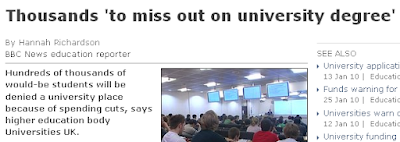
I thought this was a strange BBC News headline:

BBC News article and headline

First, there are two orders of magnitude between "thousands" (headline) and "hundreds of thousands" (body copy). A quick play with Firebug suggests that "Hundreds of thousands 'to miss out on university degree'" would fit - just - as a headline, although I grant you that it's not particularly catchy.

Second, the story isn't that people will miss out on degrees - it's that they will miss out on university places altogether (although one tends to follow the other). To me, the headline as stands suggests that thousands of people currently at university will miss out on a degree. And while that's probably true, it's not reflective of the story.

What do you call it when... someone's visual identity is unknown?

To contact us Click HERE
This query has been emailed into The Engine Room:

Is there a word which means that a person's visual identity is unknown? For example, the West End Whingers are often referred to as "anonymous" as people don't know what they look like. However, they are not anonymous as they really are called Phil and Andrew [the names given on the WEW website]. Is there a word for use in these circumstances?

Well, 'anonymous' comes from the Greek for 'nameless', whereas Phil and Andrew, I suppose, are faceless rather than nameless. However the OED defines faceless as "remote and impersonal", which isn't really what we're driving at. And whether it's true of the West End Whingers I wouldn't like to say!

Lots of other 'in-' or 'un-' words also spring to mind, such as 'incognito' or 'undisclosed', but none of them seem quite right. I imagine we're looking for another 'a-' word.

Any suggestions?

5 Şubat 2013 Salı

2012 UK-to-US WotY: bollocks

To contact us Click HERE

For the first time in six years, I feel spoil{t/ed} forchoice in deciding on a UK-to-US Word of the Year, but have a hard timethinking of even one good candidate for US-to-UK. After the 2011 UK mediafrenzy of anti-Americanismism, 2012was the year of hoopla about Britishisms in America.There were many to choose from, and before announcing my less printable choice,I’d like to give special mention to stockist, which Nancy Friedman (Fritinancy), an excellent observer of commerciallanguage, has noted on the rise in US contexts.

In manyways, I regret my choice of UK-to-US Word of the Year. In other ways, I felt Ididn’t have a choice: the word kept coming up in American contexts this year. And it is:
bollocks…which has a good AmE equivalent in bullshit. At least, the use that has come into AmE has thatequivalent. In BrE the word means ‘testicles’, and by some extension it is used tomean ‘nonsense’. But as is often the case forloanwords, the people borrowing it are not always aware of its other meanings, including the anatomical one. Another use that doesn't seem to be  making itsway across is the phrase the dog’s bollocks, which means something good—acruder, stronger and less dated version of other animal metaphors like (orig. AmE) the bee’s kneesor (now AmE) thecat’s meow. 
In support of bollocks as WotY we have Newcastle Brown Ale’s US (and not UK) advertisingcampaign:
We also have Richard Hammond of Top Gearpromoting its use in the US, before admitting that it’s already started makingits way into AmE:

Sightings in AmE start before 2012, of course. The Corpus of Historical American English, which has materials from 1810 to 2009 shows this trend in the last few decades (each column stands for a decade and each number is per approximately 25 million words).


The reason I’mnot too excited about having bollocks as my WotY, despite feeling compelled to have it,is that it joins 2006’s wankeron my list of WotYs, which means that now one third of my UK-to-US WotYs arerather crude. SbaCL continues to secure its place in the list of websitesbanned in schools.

Are Americansreally so crude that all we want is vulgar words from the UK? Absolutely not.But if you’ve ever been around exchange students, you’ll have discovered thatit’s much easier to swear in one’s second language. British vulgarities areperceived as fun and quaint in American English. They are also perceived as funand enjoyable by many British English speakers—swearing is a major Britishpastime.  
But it’s not seen as quaint, and the British are more aware ofcontexts in which these words should not be used. As I noted in a previous post, The Advertising Standards Authority's 'Deleting Expletives' [link is pdf] report of 2000 put bollocks as the 8th most offensive word according to the British public. Words lower in the 'severity of offence' list than bollocks include arsehole, twat and shit. Most British people I know would contest that ordering of offensiveness, with bollocks feeling pretty mild these days. But still, it's not something that would easily make its way onto a billboard.
So, theUK-to-US WotY for 2012 is bollocks.In so many ways. There’s still a little time to get a last-minute US-to-UK wordnomination in. I hope to post it tomorrow.

2012 US-to-UK Word of the Year: wonk

To contact us Click HERE
As I noted in the UK-to-US WotY post, this hasn't been a particularly 'big' year for American imports to Britain. Those that were nominated were mostly things that were not clearly American before they were British; that is (in many cases), though an American may have been first to use them, they immediately entered general English. Other nominations didn't seem to have anything particularly "2012" about them--they'd been steadily climbing in BrE for 10 or 20 years, with no particular notice or peak in 2012. But one nomination, by reader Joe, stood out for me.  Ladies and germs, the 2012 US-to-UK Word of the Year is


wonk
...as in policy wonk.  I'll let Joe's nomination start the talking: 
My nomination for AmE to BrE WOTY is "Wonk" as in "Policy Wonk".

Google searches of pages from the UK show a number of examples, and Oxford and Cambridge dictionaries online both list the AmE sense of the word (the Oxford also has the British Naval slang sense).

The clincher for me though was to hear “(Policy) Wonk” used on BBC Radio 4 by Jane Garvey during the 12 November broadcast of “Woman’s Hour” in a segment where she was debating “who are the women who matter in UK politics?” with Allegra Stratton, the political editor of BBC Two’s “Newsnight”. If it's on "Woman's Hour", surely that's a sign it's moving out from the "Chattering Classes / West Wing fans" and into the mainstream?

The American Heritage entry for wonk marks it as slang and defines it as:
1. A studentwho studies excessively; a grind.2. One whostudies an issue or a topic thoroughly or excessively
I have not seen the first meaning in BrE, which has its equivalent in the BrE noun swot. It's the second meaning that has been imported (showing once again that borrowings from one language/dialect to another are rarely "complete" or "faithful").
In addition to Joe's noticing it on Woman's Hour, the thing that makes this a word for 2012 is the fact that Ed Miliband (the leader of the Labour Party) flew his wonk flag at the Labour Party Conference:

That the newspaper had to provide a footnote translation of wonk (using another Americanism that's come into BrE, geek) is evidence of its relative newness in BrE.*


Wonk's entry into BrE is complicated a bit by the BrE word wonky (which is currently making inroads in AmE), which means 'unsteady; apt to malfunction; not quite right'. But that doesn't seem to be holding it back. Hail to the wonks!  And to wonk!


* This recency is not necessarily the picture you'll get if you try to find evidence of wonk's use in BrE.  Collins English Dictionary doesn't bother marking wonk as AmE and includes two Sunday Times examples from 2002. Other early examples seem more tricky to identify as BrE. There's one policy wonk in the BritishNational Corpus, way back in 1990, but it's from The Economist, in an articleabout US politics--so it was probably written by someone in the US, and perhapssomeone American. GoogleNgram viewer shows an increase in policy wonk in "BritishEnglish" books since the 1990s, but click on the link to the books, and you'll find that most seem to be American books by American authors, includingthe Oxford Dictionary of American Political Slang (by Grant Barrett) and a collection of William Safire's 'OnLanguage' columns from the New York Times Magazine. I'vesaid before that Google Ngram Viewer is not to be trusted as a source onAmE/BrE differences, and I feel the need to say it again: Google Ngram Vieweris bad at identifying American English versus British English, eventhough it gives you the option of choosing between them. Lastly, when I do acustom search on plain old Google, searching for the word on sites last updated in aparticular period, it doesn't given me the number of hits, for some reason.(What's up with that, Google?)  

untangle and disentangle

To contact us Click HERE
So, there I was, enjoying a nice evening of nothing while on (AmE) vacation/(BrE) holiday, when Dave Summers of Ohio tweeted me to ask:
Heard "disentangle" the other day. Is that perhaps BrE for "untangle"?
To which I replied, "No, it's AmE too". But then I wondered whether the rates of their use were different and I found that they were. Voilà! A Difference of the Day for my Twitter feed (which has been very sporadically updated while I've been on holiday/vacation as it gets hard to tell where one day starts and another ends). So, I tweeted:
AmE and BrE have both 'disentangle' and 'untangle'. But disentangle:untangle ratio = 2:3 in AmE and 3:1 in BrE.  (Source = COCA and BNC at Mark Davies' Corpora site.)
And I was all ready to call it a night when Gordon Hemsley of Georgia tweeted to say:
I actually think those words mean different things to me. Disentangle implies more than one thing; untangle can be 1.
...and while I thought he was probably right, I also know that it's very often the case that the stories we tell ourselves about how the differences between synonyms are often very different from how we actually use them. So, here I am researching this little thing at 1 in the morning instead of any of the other two things I have to do before bed or the opportunity to sleep that I really should take before restarting the academic term. Sigh-di-sigh-sigh-sigh.

Dictionaries don't tell us of any dialectal differences between these words, nor do they really mark Gordon's division of labo(u)r for the two words. The dictionaries I've looked at give two meanings for disentangle (or if not two meanings, then examples of both of these meanings): (1) to free something from its entanglement with something else, (2) to bring out of a tangled state, unravel.

I've started my investigation by looking at cases where the word from occurs within five words after the base forms of the verbs (untangle, disentangle). If you're removing the tangle in one thing, you probably wouldn't have a from--we don't untangle a knot from itself, we just untangle a knot.  So the from examples can be assumed to involve removing a tangle of two things (the first sense of the word, above). An example from COCA:

He managed to disentangle himself from his kayak before it was pulled into the hole.

In both dialects, there is a strong preference for using disentangle with from. So, more than 1/3 of  disentangles are closely followed by a from, and far fewer untangles have a from after them.
   

COCA (AmE)BNC (BrE)
disentangle ... from36% [76/210]37% [28/103]
untangle... from11% [35/319]15% [4/26]

So far AmE and BrE aren't looking very different. The next question is how they act when only one thing is involved, and a tangle is removed from it. To look at that, I've looked at all the forms of each verb (i.e. untangle, untangled, untangling, etc.) followed by a/an/the and then a singular noun.
   
per 100 million wordsCOCA (AmE)BNC (BrE)
disentangl* a(n)/the sg-N 820
untangl* a(n)/the sg-N2612

This is far from a thorough investigation of these two words, but what the numbers here seem to be saying is that AmE has a strong preference for untangle with singulars and that this isn't shared by BrE. This is to say that Gordon's hunch was right in terms of how these words work in AmE and that the BrE use that Dave heard probably struck him as strange because it wasn't obeying the untangle-goes-with-singulars preference. Note that these differences are about preferences and probabilities of the uses of two senses of the words, not about one word (or even one sense of a word) being 'British' or 'American'. But they're still differences.

You know, this was an awful lot like work! I've only got three more days off.* Enough of this!**


* Vacation/holiday is, of course, irrelevant, since the blog isn't part of the job that I'm taking a break from. As my hobby, the blog is, I suppose, what I should be doing on my holiday/vacation. You know, instead of getting sleep or spending time with my family. Priorities, eh?

** Except to tell you that the 'fight with' sense of tangle is originally AmE. Just because I can't stop telling you things.
Thousands 'to miss out on university degree'

To contact us Click HERE
I thought this was a strange BBC News headline:

BBC News article and headline

First, there are two orders of magnitude between "thousands" (headline) and "hundreds of thousands" (body copy). A quick play with Firebug suggests that "Hundreds of thousands 'to miss out on university degree'" would fit - just - as a headline, although I grant you that it's not particularly catchy.

Second, the story isn't that people will miss out on degrees - it's that they will miss out on university places altogether (although one tends to follow the other). To me, the headline as stands suggests that thousands of people currently at university will miss out on a degree. And while that's probably true, it's not reflective of the story.

What do you call it when... someone's visual identity is unknown?

To contact us Click HERE
This query has been emailed into The Engine Room:

Is there a word which means that a person's visual identity is unknown? For example, the West End Whingers are often referred to as "anonymous" as people don't know what they look like. However, they are not anonymous as they really are called Phil and Andrew [the names given on the WEW website]. Is there a word for use in these circumstances?

Well, 'anonymous' comes from the Greek for 'nameless', whereas Phil and Andrew, I suppose, are faceless rather than nameless. However the OED defines faceless as "remote and impersonal", which isn't really what we're driving at. And whether it's true of the West End Whingers I wouldn't like to say!

Lots of other 'in-' or 'un-' words also spring to mind, such as 'incognito' or 'undisclosed', but none of them seem quite right. I imagine we're looking for another 'a-' word.

Any suggestions?